


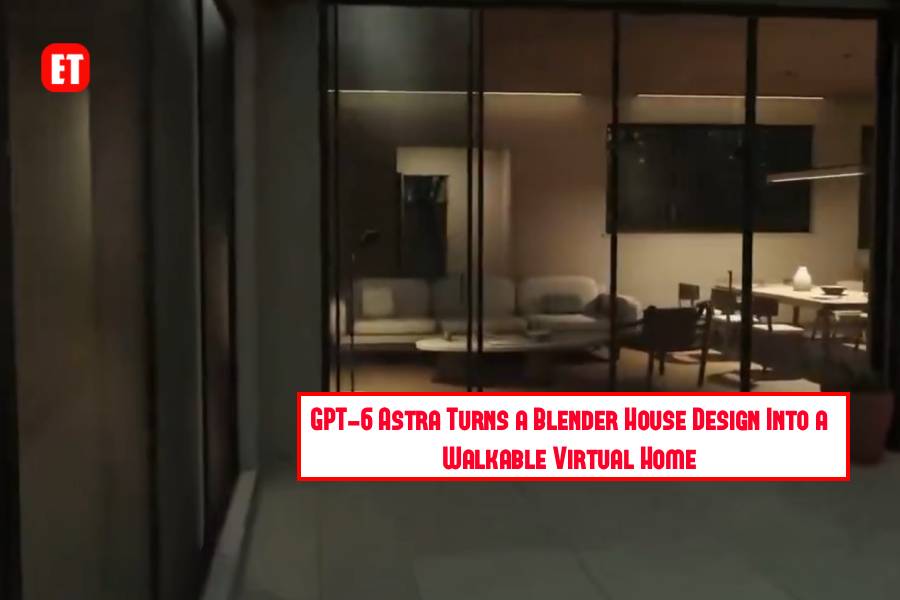
- A viral post shows GPT-6 Astra transforming a real house model created in Blender into a walkable Unreal Engine 5 environment.
- The technology could allow designers and clients to experience a real property digitally before construction or renovation work begins.
- The post has attracted more than 800,000 views and strong reactions from AI, design and technology users.
- Commenters are already discussing potential applications for architecture and real estate.
- Questions remain about Astra’s availability, cost and exactly how the process works.
A new post showcasing the capabilities of GPT-6 Astra is drawing widespread attention after showing how a real house can be transformed into an interactive, walkable environment in Unreal Engine 5.
The post, shared by Chris (@ChrisGPT) on September 3, features footage of a realistic modern home interior, including a kitchen, dining area, furniture and large glass surfaces. According to the post, the house was modeled in Blender and then turned into a walkable scene in Unreal Engine 5, allowing people to experience the space digitally.
The important part of the demonstration is not simply the quality of the rendering. It is the ability to take an existing real-world house design and turn it into an environment that can be explored from inside.
That possibility could have major implications for architects, designers, property developers and real estate companies. Instead of showing clients only drawings, floor plans or conventional renders, professionals could potentially give them an interactive version of a property that they can walk through and examine before the physical work is completed.
The post quickly gained attention online, collecting more than 800,000 views along with thousands of likes and hundreds of reposts. The response has included excitement from people who see the technology as a significant step forward for AI-assisted design.
One commenter described the idea simply as “Walkable before it’s even built,” capturing what many viewers found most impressive about the technology.
The discussion also moved toward possible business applications. One user suggested that services built around this type of technology could eventually be offered to real estate agencies as SaaS or mini-SaaS products. Such tools could allow agencies to create immersive property experiences for clients without requiring them to physically visit a location.
Others were more interested in the technical process. Several commenters asked what prompt was used, while another questioned the cost and whether the resulting environment was genuinely photorealistic.
There was also some debate about the technology’s availability. One commenter pointed out that Astra is not yet publicly available, highlighting the gap that can exist between an impressive AI capability and a tool that ordinary users can actually access.

Despite those questions, the reaction shows how quickly expectations around AI-generated environments are changing. AI is increasingly being discussed not only as a tool for creating pictures and text, but also as a way of transforming existing digital assets into interactive spaces.
For architects and designers, that could eventually make it easier for clients to understand a property before it is built. A person could potentially walk through a planned home, inspect its layout and get a much clearer sense of how the finished space will feel.
For real estate, the possibilities are equally significant. Properties could potentially be presented through interactive virtual environments, giving prospective buyers a better understanding of a home without relying entirely on photographs or static renders.
The post does not provide all the technical details needed to determine exactly how much of the process was automated, but the result has clearly captured people’s attention.
If this kind of workflow becomes widely available, the line between architectural visualization and an actual interactive digital version of a property could become much thinner — allowing people to experience a home virtually long before they step inside the real one.

Erime Editor is the official editorial account of ErimeToday. Articles published under this name are created, reviewed, and managed by the ErimeToday editorial team to deliver helpful guides, technology tips, relationship advice, daily accurate word game answers, anime updates, gaming content, manga insights, news, and useful resources for readers around the world.