

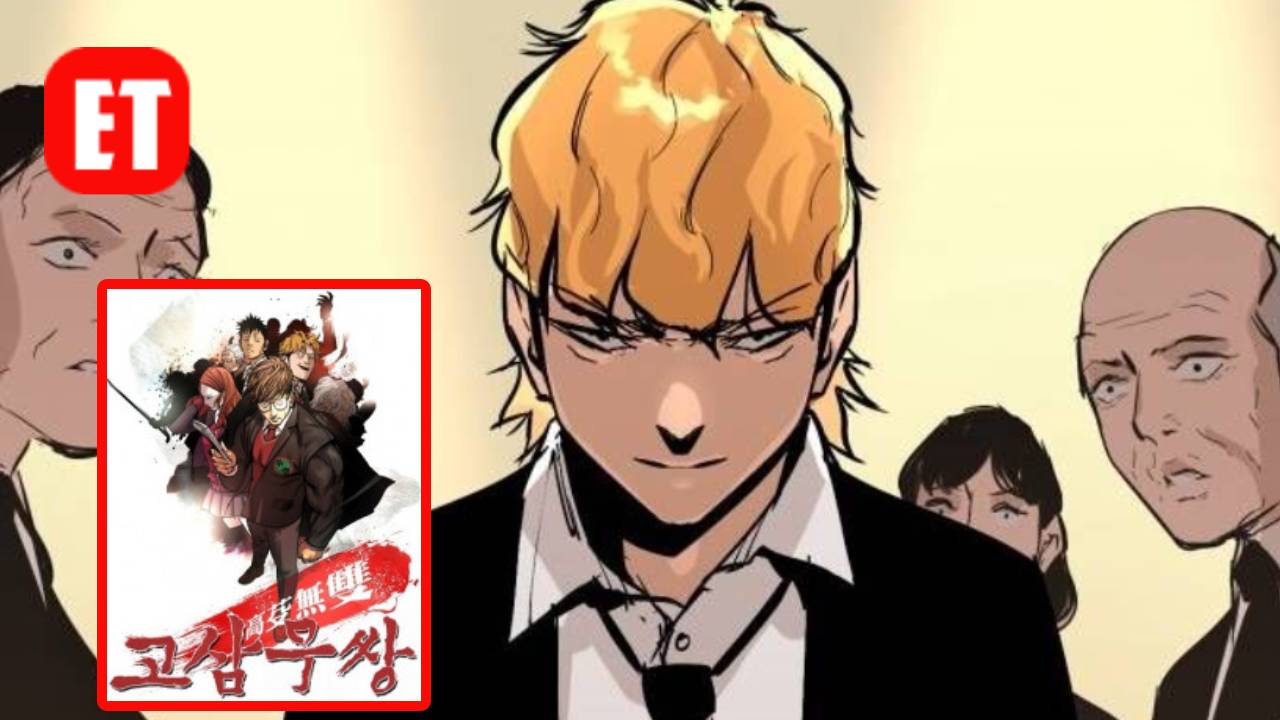
The Gosam Mussang manga arrives like a buried chronicle unearthed at the exact moment history decides to repeat itself. Written by B-gyup Dal’gung, the series frames its story around a striking idea: while the modern world believes martial arts legends have faded into myth, the truth is that thousands of years of conflict, technique, and bloodline rivalry have simply gone underground. Gosam Mussang pulls those ancient struggles into the present day, choosing an unexpected battlefield—a contemporary high school—where fists, discipline, and inherited will collide.
From its opening chapter, Gosam Mussang establishes a dual timeline. The narration speaks of forgotten eras when martial masters ruled the shadows, settling disputes through combat that shaped clans and secret societies. That past does not remain distant for long. The story shifts to the present, introducing a seemingly ordinary high school whose students include descendants of those ancient lineages. The protagonist enters as an unassuming transfer student, calm, observant, and clearly carrying more than textbooks in his bag. Early chapters focus on grounding readers in daily school life while dropping subtle hints—unnatural reflexes, suppressed strength, and cryptic remarks from teachers who know more than they should.
As the chapters progress, the illusion of normalcy breaks. A confrontation between students escalates beyond typical school violence, revealing martial techniques refined over centuries. This moment becomes the series’ first true awakening, both for the protagonist and the reader. Gosam Mussang makes it clear that this is not a story about delinquency alone, but about legacy. Each fighter represents a philosophy shaped by history: restraint versus domination, tradition versus evolution, survival versus honor.
Midway through the early chapters, the manga begins expanding its cast. Rival schools are introduced, each acting as a front for a different martial faction. These chapters read like investigative reports, unveiling the structure of the hidden martial world piece by piece. Leaders are identified, alliances hinted at, and grudges traced back hundreds of years. B-gyup Dal’gung excels at tying personal conflict to historical consequence, ensuring that every punch thrown in a hallway echoes an ancient feud.

The second major arc deepens the psychological stakes. Training sequences replace exposition, revealing how martial knowledge is passed down not just through technique, but through memory and pain. Flashbacks become more frequent, transporting readers to eras where survival demanded absolute mastery. These chapters clarify the manga’s central theme: martial arts are not simply about strength, but about responsibility. Characters who abuse their heritage face consequences, while those who question it struggle to define their own identity.
As tensions rise, Gosam Mussang introduces an organized underground tournament disguised as inter-school rivalry. These chapters are some of the most kinetic in the series, blending tightly choreographed combat with narrative revelations. Fighters unveil signature techniques tied to ancient schools thought long destroyed. The protagonist’s own abilities come into sharper focus here, though the manga deliberately withholds full disclosure. Instead, readers are shown fragments—movements too refined for his age, instincts that suggest experience beyond a single lifetime.
The tournament arc also marks a tonal shift. Injuries become more severe, and the cost of fighting is no longer abstract. Characters are hospitalized, reputations collapse, and families intervene from the shadows. Through these chapters, Gosam Mussang critiques the romanticization of martial tradition, exposing how generations of violence perpetuate cycles of loss. The high school setting, once a novelty, now feels like a pressure cooker, trapping young fighters in conflicts they never chose.
Later chapters widen the scope again, revealing that the school-level conflicts are merely proxies for a larger power struggle. Ancient organizations move openly for the first time, deploying enforcers and manipulating outcomes. Political maneuvering takes center stage alongside combat, and information becomes as lethal as physical force. These chapters read like a slow-burning exposé, connecting earlier hints into a coherent conspiracy that has been shaping society from behind the curtain.
One of the most significant turning points comes when the protagonist’s lineage is partially revealed. Rather than a triumphant moment, it is presented as a burden. The revelation reframes earlier chapters, casting previous restraint as fear of repeating history rather than lack of confidence. This moment underscores B-gyup Dal’gung’s commitment to character-driven storytelling. Power is never portrayed as a reward; it is an inheritance that demands reckoning.
In the final stretch of currently released chapters, Gosam Mussang returns to its roots: direct confrontation. However, these battles carry a different weight. Fighters no longer clash to prove dominance, but to end cycles that have defined their lives. Techniques once used to kill are repurposed to incapacitate, signaling a philosophical shift among the younger generation. The high school, once merely a setting, becomes a symbol of transition—a place where the past is confronted so the future can diverge.
The most recent chapters leave the story at a tense crossroads. Alliances remain fragile, ancient leaders are not fully defeated, and the line between tradition and reform remains contested. Rather than offering closure, Gosam Mussang chooses uncertainty, mirroring real history where progress is never clean or guaranteed. Readers are left with the sense that the greatest battle ahead is not physical, but ideological.
Across all its chapters, Gosam Mussang distinguishes itself by treating martial arts as living history rather than spectacle alone. B-gyup Dal’gung writes with the precision of a chronicler, ensuring that every conflict serves a narrative purpose. The manga’s strength lies in its refusal to simplify legacy into heroism or villainy. Instead, it presents martial tradition as a force that can protect, corrupt, or imprison depending on how it is carried forward.
As Gosam Mussang continues, its appeal rests in this careful balance between action and reflection. It is a story about fists and footwork, but also about memory, inheritance, and choice. In placing centuries of martial history within the walls of a modern high school, the series delivers a compelling reminder that the past never truly sleeps—it waits, watching, until the next generation decides how it will fight.